

Implement macOS Beauty
Add SDK Dependency
Method A: CocoaPods Integration (Recommended)
Add the Facebetter dependency to your project's Podfile:
target 'YourTargetName' do
  # Please replace with the latest version
  pod 'Facebetter', '1.2.2'
end
Run the installation command:
pod installXcode 15+ Compilation Error Handling
If you are using Xcode 15 or later, you might encounter a Sandbox: rsync.samba deny(1) error during compilation. This is caused by Xcode's default User Script Sandboxing being enabled.
Solution:
- Select your Project in Xcode.
- Navigate to the Build Settings tab.
- Search for
ENABLE_USER_SCRIPT_SANDBOXING. - Change its value from
YestoNo.
Method B: Manual Framework Integration
Go to the Download page to get the latest SDK, then extract it.
Copy the Facebetter.framework library from the SDK package to your project path.
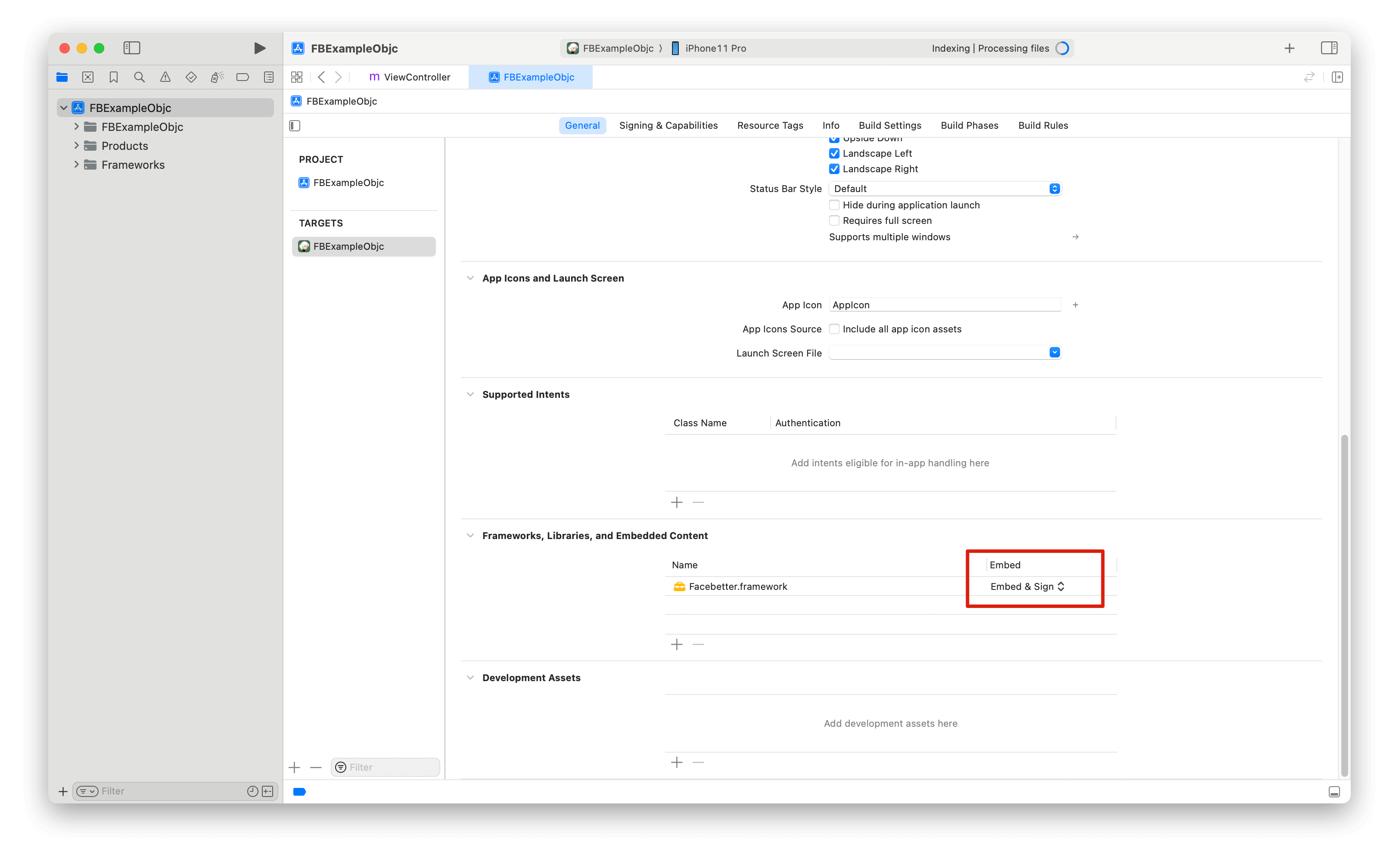
Open Xcode and refer to this guide to add the Facebetter.framework dynamic library. Make sure the Embed property of the added dynamic library is set to Embed & Sign.
Permission Configuration
Ensure network permissions are enabled for appkey validation 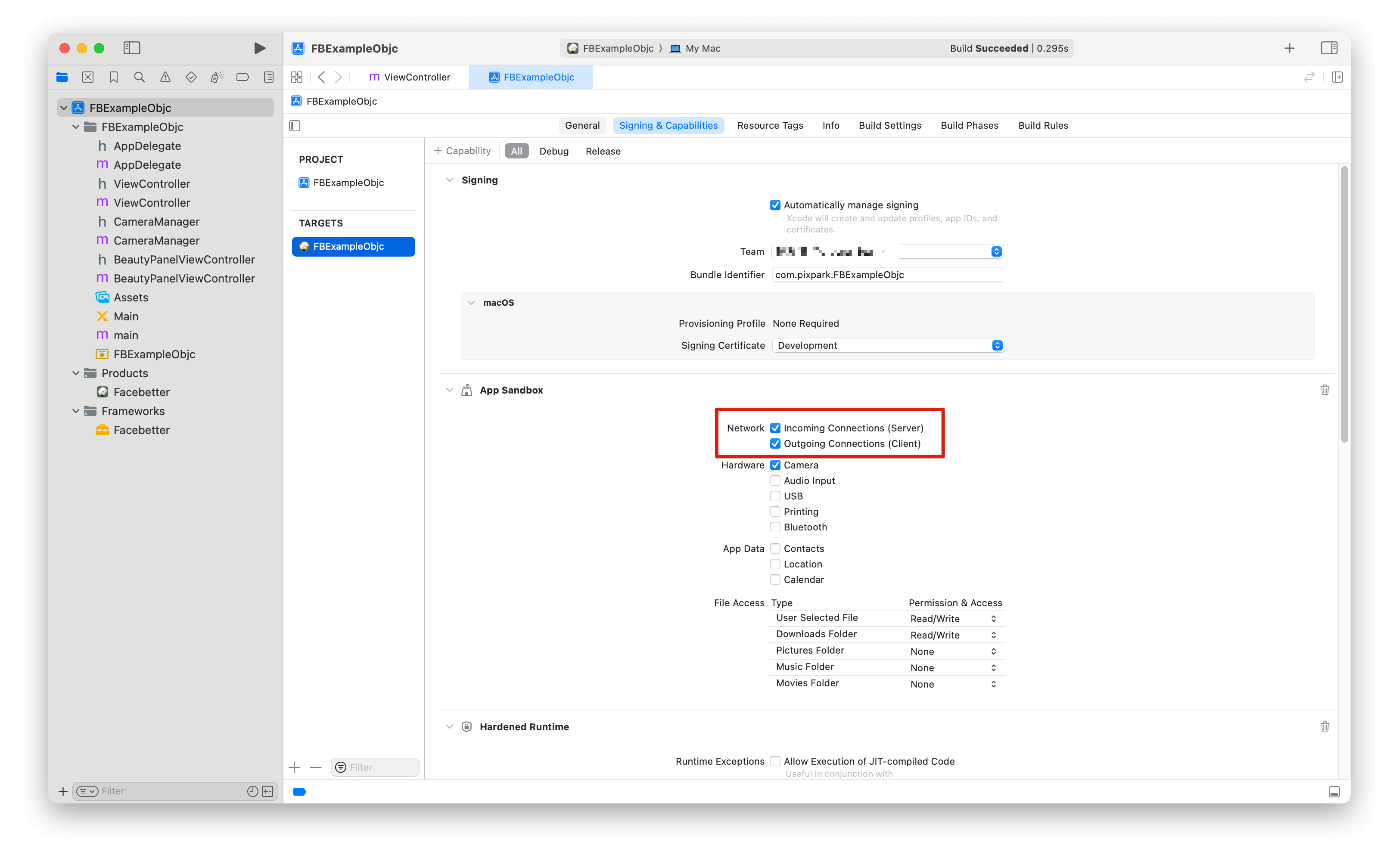
Permission Descriptions:
- Network Permission: Required. SDK needs network connection to verify
appIdandappKeyto ensure the app runs normally.
Import Header Files
#import <Facebetter/FBBeautyEffectEngine.h>Log Configuration
Logging is disabled by default and can be enabled as needed. Both console logging and file logging switches are supported.
WARNING
Logging should be enabled before creating the beauty engine, otherwise you may not see initialization logs.
FBLogConfig* logConfig = [[FBLogConfig alloc] init];
// Log level
logConfig.level = FBLogLevel_Info;
// Console logging
logConfig.consoleEnabled = YES;
// File logging
logConfig.fileEnabled = YES;
logConfig.fileName = @"log path: xx/xx/facebetter.log";
Create Configuration Engine
Follow the instructions on this page to get your appid and appkey.
Verification Priority:
- If
licenseJsonis provided, use license data verification (supports online response and offline license) - Otherwise, use
appIdandappKeyfor automatic online verification
FBEngineConfig *engineConfig = [[FBEngineConfig alloc] init];
engineConfig.appId = @"your appId";     // Configure your appid (optional, not required if licenseJson is provided)
engineConfig.appKey = @"your appkey";   // Configure your appkey (optional, not required if licenseJson is provided)
// Optional: Use license data verification (takes priority if provided)
// engineConfig.licenseJson = @"your license json string";
self.beautyEffectEngine = [FBBeautyEffectEngine createEngineWithConfig:engineConfig];
Error Handling
After creating the engine, it's recommended to check if it was successful:
if (self.beautyEffectEngine == nil) {
    NSLog(@"Failed to create beauty engine");
    return;
}
Using Filters and Stickers
Filters and stickers need to be registered as resource files (.fbd) first, and then set via their ID.
Filters
// 1. Register filter resource (usually executed once after initialization)
NSString *filterId = @"chuxin";
NSString *fbdPath = [[NSBundle mainBundle] pathForResource:@"chuxin" ofType:@"fbd"];
[self.beautyEffectEngine registerFilter:filterId fbdFilePath:fbdPath];

// 2. Set filter
[self.beautyEffectEngine setFilter:filterId];

// 3. Adjust intensity (0.0 - 1.0)
[self.beautyEffectEngine setFilterIntensity:0.8f];

// 4. Clear filter
[self.beautyEffectEngine setFilter:nil];
Stickers
// 1. Register sticker resource
NSString *stickerId = @"glasses";
NSString *fbdPath = [[NSBundle mainBundle] pathForResource:@"glasses" ofType:@"fbd"];
[self.beautyEffectEngine registerSticker:stickerId fbdFilePath:fbdPath];

// 2. Set sticker
[self.beautyEffectEngine setSticker:stickerId];

// 3. Clear sticker
[self.beautyEffectEngine setSticker:nil];
Adjust Beauty Parameters
TIP
All beauty parameters range from [0.0, 1.0]. Set to 0 to disable the effect.
Set Skin Beauty Parameters
Use the setBasicParam interface to set skin beauty parameters. Parameter range [0.0, 1.0].
[self.beautyEffectEngine setBasicParam:FBBasicParam_Smoothing floatValue:0.5f];Supported skin beauty parameters:
typedef NS_ENUM(NSInteger, FBBasicParam) {
  FBBasicParam_Smoothing = 0,  // Smoothing
  FBBasicParam_Sharpening,     // Sharpening
  FBBasicParam_Whitening,      // Whitening
  FBBasicParam_Rosiness,       // Rosiness
};
Set Skin-Only Beauty
Use the setSkinOnlyBeauty: interface to set whether beauty effects are applied only to skin regions. When enabled, beauty effects (smoothing, whitening, etc.) will only be applied to detected skin areas, leaving non-skin areas unchanged.
// Enable skin-only beauty
[self.beautyEffectEngine setSkinOnlyBeauty:YES];

// Disable skin-only beauty (apply to entire image)
[self.beautyEffectEngine setSkinOnlyBeauty:NO];
TIP
After enabling skin-only beauty, even with high beauty parameter values, non-skin areas (such as background, clothing, etc.) will not be affected.
Set Face Reshape Parameters
Use the setReshapeParam interface to set face reshape parameters. Parameter range [0.0, 1.0].
[self.beautyEffectEngine setReshapeParam:FBReshapeParam_FaceThin floatValue:0.5f];Supported face reshape parameters:
typedef NS_ENUM(NSInteger, FBReshapeParam) {
  FBReshapeParam_FaceThin = 0,  // Face thinning
  FBReshapeParam_FaceVShape,    // V-shaped face
  FBReshapeParam_FaceNarrow,    // Narrow face
  FBReshapeParam_FaceShort,     // Short face
  FBReshapeParam_Cheekbone,     // Cheekbone
  FBReshapeParam_Jawbone,       // Jawbone
  FBReshapeParam_Chin,          // Chin
  FBReshapeParam_NoseSlim,      // Nose slimming
  FBReshapeParam_EyeSize,       // Eye enlargement
  FBReshapeParam_EyeDistance,   // Eye distance
};
Set Makeup Parameters
[self.beautyEffectEngine setMakeupParam:FBMakeupParam_Lipstick floatValue:0.5f];Supported makeup parameters:
typedef NS_ENUM(NSInteger, FBMakeupParam) {
  FBMakeupParam_Lipstick = 0,  // Lipstick
  FBMakeupParam_Blush,         // Blush
};
Set Virtual Background
Enable virtual background through the setVirtualBackground interface:
// Set background mode
FBVirtualBackgroundOptions *options = [[FBVirtualBackgroundOptions alloc] initWithMode:FBBackgroundModeBlur];
[self.beautyEffectEngine setVirtualBackground:options];

// Set background image (need to set to Image mode first)
FBVirtualBackgroundOptions *imageOptions = [[FBVirtualBackgroundOptions alloc] initWithMode:FBBackgroundModeImage];
imageOptions.backgroundImage = backgroundImageFrame;  // FBImageFrame object
[self.beautyEffectEngine setVirtualBackground:imageOptions];
Set Engine Callbacks
Monitor engine events (license validation and engine initialization status):
FBEngineCallbacks *callbacks = [[FBEngineCallbacks alloc] init];
callbacks.onEngineEvent = ^(FBEngineEventCode code, NSString* _Nullable message) {
    if (code == FBEngineEventCodeLicenseValidationSuccess) {
        // License validation succeeded
        NSLog(@"License validation succeeded");
    } else if (code == FBEngineEventCodeLicenseValidationFailed) {
        // License validation failed
        NSLog(@"License validation failed: %@", message);
    } else if (code == FBEngineEventCodeInitializationComplete) {
        // Engine initialization completed
        NSLog(@"Engine initialization completed");
    } else if (code == FBEngineEventCodeInitializationFailed) {
        // Engine initialization failed
        NSLog(@"Engine initialization failed: %@", message);
    }
};
[self.beautyEffectEngine setCallbacks:callbacks];
Event codes:
FBEngineEventCodeLicenseValidationSuccess(0): License validation succeededFBEngineEventCodeLicenseValidationFailed(1): License validation failedFBEngineEventCodeInitializationComplete(100): Engine initialization completedFBEngineEventCodeInitializationFailed(101): Engine initialization failed
Process Images
Create Images
Image data is encapsulated through FBImageFrame, supporting formats: YUVI420, NV12, NV21, RGB, RGBA, BGR, BGRA.
Create FBImageFrame with RGBA
FBImageFrame *input_image = [FBImageFrame createWithRGBA:data width:width height:height stride:stride];Create FBImageFrame with image file
FBImageFrame *input_image = [FBImageFrame createWithFile:@"xxx.png"];Rotate Images
FBImageFrame has built-in image rotation methods that can be used as needed.
- (int)rotate:(FBImageRotation)rotation;Rotation angles
typedef NS_ENUM(NSInteger, FBImageRotation) {
  FBImageRotation0,    // 0 degrees
  FBImageRotation90,   // Clockwise 90 degrees
  FBImageRotation180,  // Clockwise 180 degrees
  FBImageRotation270,  // Clockwise 270 degrees
};
Process Images
processMode includes Video and Image modes. Video mode is suitable for live streaming and video scenarios with higher efficiency. Image mode is suitable for image processing scenarios.
input_image.type = FBFrameTypeVideo;
FBImageFrame *output_image = [self.beautyEffectEngine processImage:input_image];
TIP
The engine automatically maintains input/output format consistency. If input is RGBA format, output is RGBA format; if input is I420 format, output is I420 format.
Get Processed Image Data
FBImageBuffer* buffer = [output_image toRGBA];
uint8_t* data = [buffer data];
int data_size = buffer.size;

int width = buffer.width;
int height = buffer.width;
int stride = buffer.stride;
Get I420 data
FBImageBuffer* buffer = [output_image toI420];
// Get continuous I420 memory data
uint8_t* data = [buffer data];
// Get I420 data length
int data_size = buffer.size;
// Get Y, U, V component data separately
uint8_t* dataY = [buffer dataY];
uint8_t* dataU = [buffer dataU];
uint8_t* dataV = [buffer dataV];

int strideY = buffer.strideY;
int strideU = buffer.strideU;
int strideV = buffer.strideV;
FBImageFrame can be converted to various formats through built-in toXXX methods: YUVI420, NV12, NV21, RGB, RGBA, BGR, BGRA. These methods can be used for format conversion.
Lifecycle Management
TIP
FBBeautyEffectEngine is a singleton and is automatically released when the app ends. Manual management is not required.
Release Resources
When ViewController is destroyed, be sure to release engine resources:
- (void)dealloc {
    if (self.beautyEffectEngine) {
        // Note: FBBeautyEffectEngine is a singleton, usually doesn't need manual release
        // But if there are custom cleanup logic, it can be handled here
        self.beautyEffectEngine = nil;
    }
}
Memory Management
- Release
FBImageFrameandFBImageBufferobjects timely - Avoid repeatedly creating large numbers of image objects in loops
- Recommend reusing
FBImageFrameobjects
// Release resources after use
if (inputImage) {
    inputImage = nil; // ARC will automatically release
}
if (outputImage) {
    outputImage = nil; // ARC will automatically release
}
if (buffer) {
    buffer = nil; // ARC will automatically release
}
Related Documentation
- Best Practices - Performance optimization and architecture design recommendations
- Common Issues - Common questions and troubleshooting
- API Reference - Complete API documentation